Burning the Archives
A Trip Through One Little Company’s History and the Lead-up to Its Death

One of my favorite past-times is digging through people’s crap.
I grew up in a house that, let’s say, full of … things. Friends would say, with a bit of a grimace, “It’s not a hoarder house! It’s… it’s just a bit… cluttered.”
We lived in a farm house, and I spent my childhood climbing through the out- buildings, which were full of impenetrable heaps of junk. Closets were crammed full. There were junk drawers. A junk room.
I loved it.
Growing up in the country, I spent a lot of time alone. Before I knew how to read, I explored. I dug through the junk and found many fascinating treasures. Even the freshly plowed fields held objects of interest — colored glass slag, bits of meteorites, and arrowheads. The woods had a collapsed corncrib for a heart and buckeyes for blood cells. It was the backdrop to my wild imagination.
It is 30 years later and I am wearing dress shoes and a lone-worker device.
I am crouched in a warehouse across the street from work, dragging out piles of boxes of papers. I slam one down on the concrete floor and dust billows out. As I handle each paper, my fingertips grow sticky, then grey and tacky. I get into a rhythm, pulling off paper clips, tossing away crumbling binders, and looking at dot-matrix printouts and the bleed of lateral flow test results taped to a lab notebook page from 1985.
One box full. I take a Sharpie and write SHRED on a neon pink label and roll it delicately onto the yellowed banker’s box. I toss the crushed lid away and heave the beginning of 40 years of my ancestors’ livelihoods into the metaphorical burn pile.
Next box, chosen at random. 2005. It seems they’ve entered the modern world and the headers of faxes have been replaced with e-mail headers. I find a reservation ticket addressed to the CEO to a resort. Falling out of a binder of data is an invitation to the company holiday party at a golf course, printed in Brush Script MT on papyrus-like paper, with a full menu.
Up to this point, I hadn’t recognized anyone’s name. But here there are dozens of printed e-mails from Joan DiMaggio, someone I remember from when I started working there back in 2018. She was an administrative assistant and was quietly laid off within two years of our acquisition by a massive global company.
As I briefly lay eyes on each page, I see that back then, she did the outbound e-mail for everyone. Sent reports, filed for certifications, arranged business deals. Joan had the important job of fielding calls and messages and getting them to the correct person, of sorting out the junk and deflecting the sales people, of arranging conferences, identifying opportunities, and keeping absolutely everything in order so that everyone else could focus on their jobs.
Huh. What a concept.
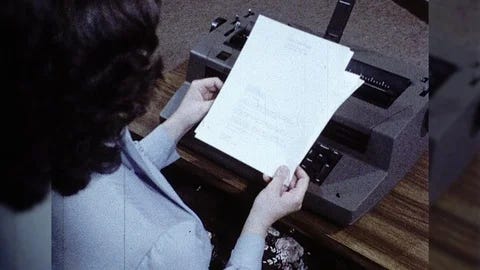
What I remembered back from the 2018 days of computer towers and the company intranet was that she was there every morning at the front desk, and I remember her not being particularly friendly for a receptionist.
But I see now that Joan wasn’t a receptionist. She wasn’t there to greet us all with a smile with her hands folded neatly on the desk before her, arranging pens to pass the time. She was keeping the entire place held together. And that is precisely the job that large corporations believe isn’t worth paying anyone for.
My mind starts churning. Shift all that onto the individual employee. They’ll spend so much time mired down in admin that they won’t be able to actually, well, do their jobs… unless they work faster and harder.
Huh.
Throwing Joan’s emails into the shred box reminds me of when my boss had us all track how much time we spent on different activities for tax purposes. I remember her astonishment when I said that I, as a laboratory researcher, spent 45% of my time on administrative tasks.
This triggers another memory, from 2022. I remember sitting in hour after hour of meetings and trying to get through my emails and schedule travel and - and - and - and panicking because it was 4:00 PM and I still had to start an experiment. Meanwhile, my colleague was scheduled to attend five days of 6-hour-long meetings at 1:00 AM because the Massive Global Company decided to enact a travel ban, and the meeting in France “has a virtual option, anyway”. What went unsaid is that he was expected to still do all of his normal work… because he wasn’t traveling.
Wow, the digital age makes everyone so much more productive. We can eliminate obstacles, reduce overhead, and streamline everything!
I snap out of my reverie and continue tearing data out of binders. There are several of them the size of family bibles, the ancient ones that came from the mother country and creak when you open them. I pull twenty paper clips out. Twenty giant studies. All done in six months. Jesus God, how did they do this? How did they get so much done? I toss it in the next shred box.
Something hits me and I sit down on a box and feel a heaviness in my chest. I know it’s not the dust in the air. It’s the feeling of profundity, of all of this — all of this — five pallets of banker’s boxes of data and e-mails and certifications and study reports — being suddenly so meaningless.
What was it all for?
What was the point if some millennial was just going to come in thirty years later and throw it all in the trash?
— when the retention policy disappears because the site itself is being dissolved?
A song comes into my head.
… and I discover that my castles stand
upon pillars of salt and pillars of sand.
I consider the sort of meaninglessness I felt mixed in with the lingering sense of meaning in my last post.
All this ephemera held in my fingers had meaning to the people who made it happen, at least in the moment. At the same time, it was also just a means to an end — a paycheck, a boosted sales number, another study, another certification.
Why do I want to touch every page, read every name?
Why do I want to hold onto all this… junk?
None of these papers mean anything anymore. They’re simply brief views into the past, evidence that someone did something once.
My parents stuffed outbuildings and rooms full of junk, creating the archive of their lives. This is still useful. We can use this someday. This will be good for something. Remember when…? Every piece of clothing and toy and doodad was evidence that we had lived and done particular things and maybe even had fun.
What went unsaid was that throwing it away meant throwing away a part of themselves, of his father, of her grandmother. In tossing the item in the trash, you were vanquishing the moment that the item meant enough to be stored away.
And so the archive stacked and stacked and filled every space.
Five pallets of banker’s boxes of data and e-mails and certifications and study reports, hundreds of written words and initials, all with the desperate scrawl “KEEP” on top.
The guy at Massive Global Company who is leading the team that is taking over our jobs flew in last week to look at all of it and decide what gets stored in an offsite, secure facility.
He took one look at the collapsing boxes, saw how yellow the paper was, and told me to throw it all out.
“We’ll have to pay to even look at this.”
They’ll have to pay to even acknowledge that there ever was a past.
I remember a time when I visited the Kurt Vonnegut museum back in Indianapolis, where they had a crushed packet of cigarettes on display in a glass case.
The place was dead that day, but the sun was pouring in. The lone museum employee hovered beside me and told me that after Vonnegut died and they were clearing out his stuff, they pulled his desk out from the wall and found the packet with a single cigarette that had fallen behind there, probably decades earlier.
And now it’s immortalized in a glass cube.
Back in my warehouse, I pull two 5” floppy disks with typewritten labels out of the pile and walk back across the street.
I put them on Carl’s desk. He’s been here longer than anyone else. He’s the lone survivor of nearly all the eras — over 30 years.
By leaving them on his desk, I say, “I see you.”
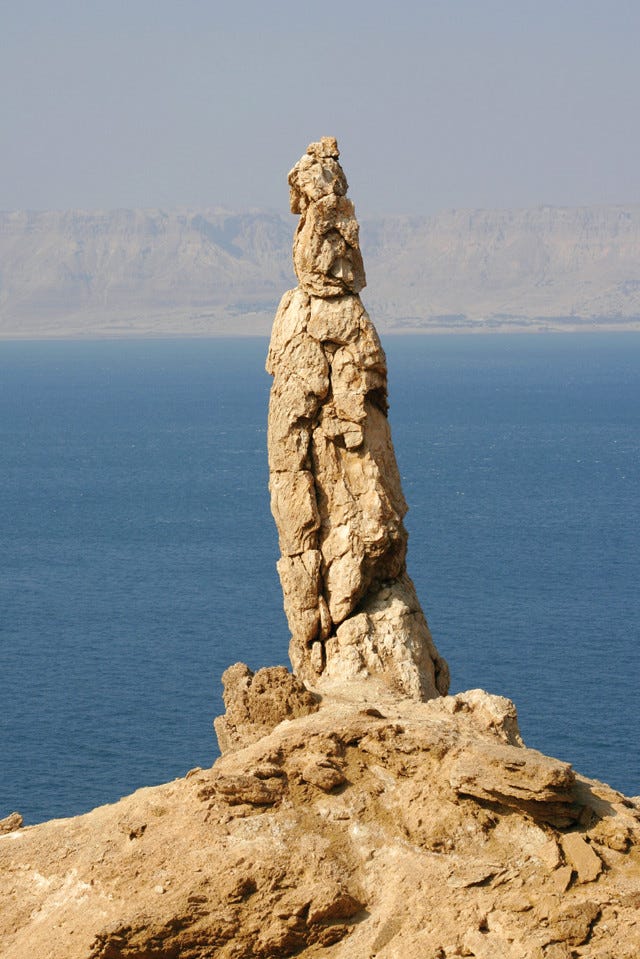
And Lot’s wife, of course, was told not to look back where all those people and their homes had been. But she did look back, and I love her for that, because it was so human. So she was turned into a pillar of salt. So it goes. - Kurt Vonnegut
Beautifully written
Wow, what a writer you are, i thoroughly enjoyed the pacing of your writing, you know how to tell a story.
I enjoyed reading this piece, part nostalgia, part disillusionment with the future of the workplace.
Are you still in research? If so would you say that your field is protected from corporate/AI encroachment?